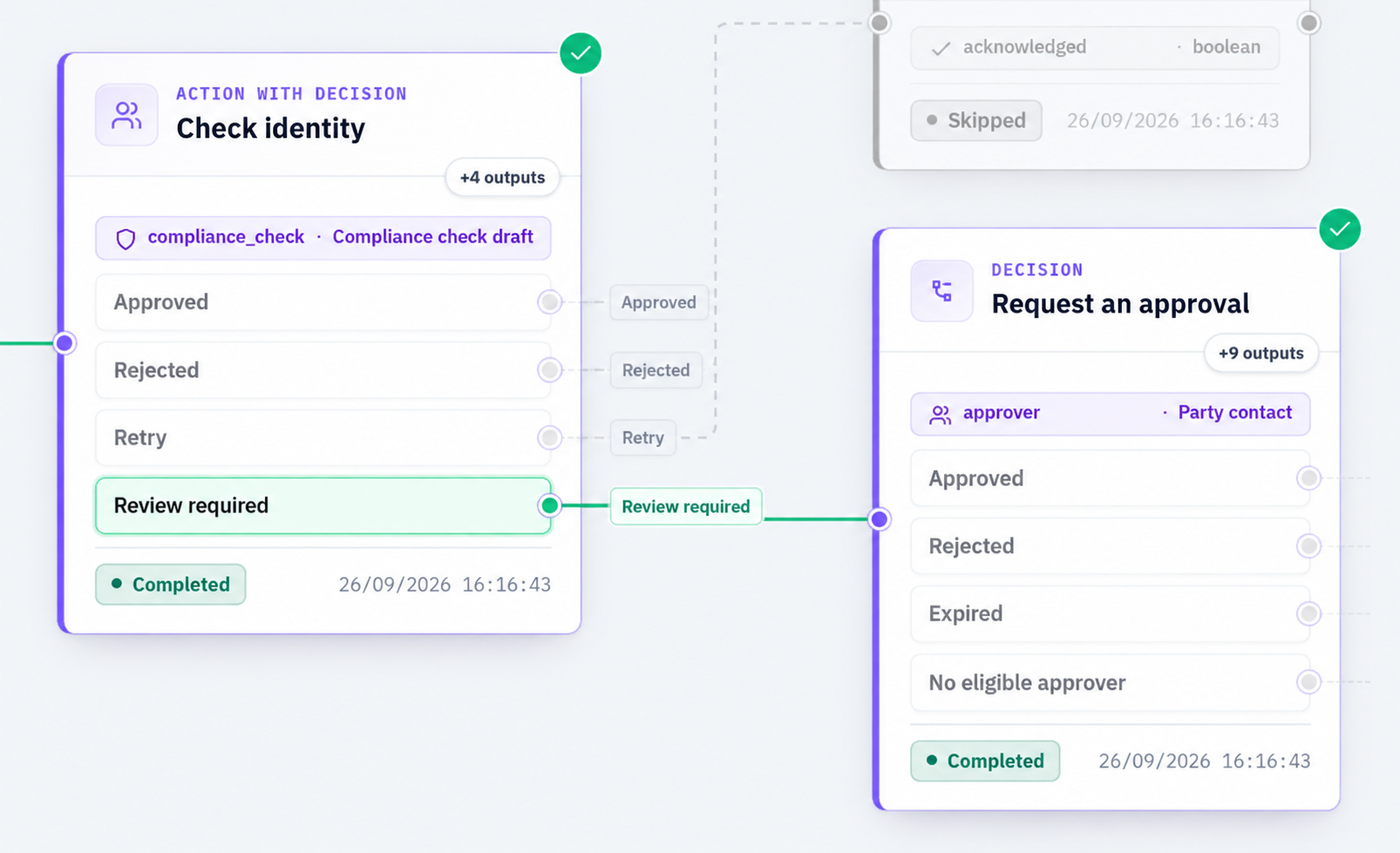
Node state
Identify which step completed, failed, is waiting or emitted a warning.
A process instance keeps the execution state of its nodes, waiting steps, routes, warnings and outputs that are safe to expose. The exact process revision stays associated with the instance.
That distinction matters during change: operators can inspect an older running instance without mentally applying the current editor state to it.
Identify which step completed, failed, is waiting or emitted a warning.
Inspect observable inputs and outputs in the same business vocabulary used by the process.
Move from a Process step to the Decision Run or Agent Run responsible for that specialised evaluation.
Generic observability does not display sensitive or secret values directly. It shows that protected data exists and preserves the class needed by downstream execution.
When a protected persistent value must be inspected for diagnosis, reveal is targeted: the user selects one masked value, provides the required reason and views it temporarily. Reveal is audited; it is not a global “show secrets” mode.
An Agent Run can record the activity, revision, observable data, tool calls, outputs and warnings. This proves what execution path occurred, but it does not invent a business explanation automatically.
If an operation requires a reason, evidence or confidence score, that information should be part of the activity output or the appropriate business object contract.